How to use public transport in Kuala Lumpur (& the Klang Valley)
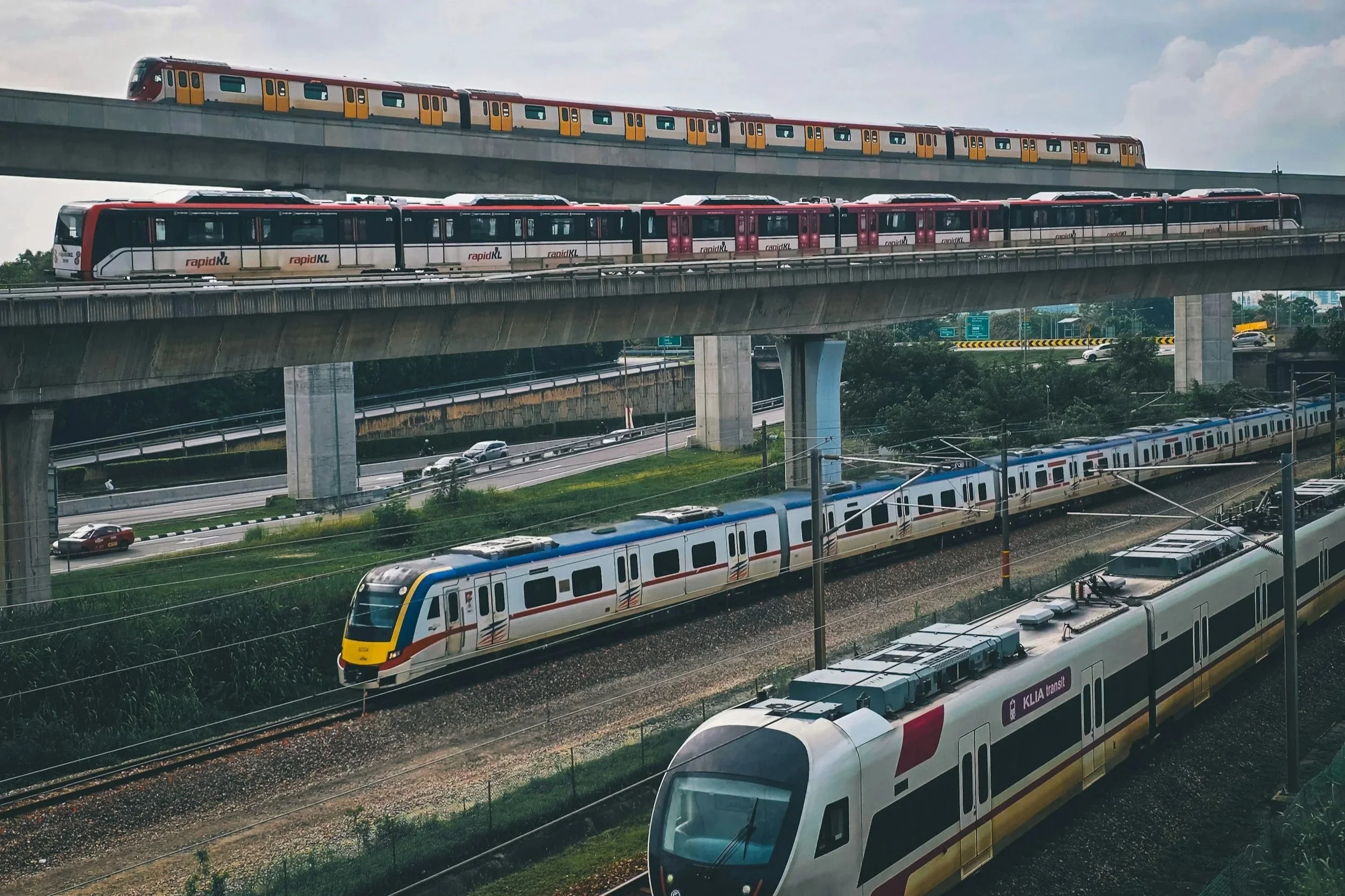
Public transport is what you take when driving isn’t an option – cheaper than petrol, cheaper than parking, and perfectly functional if you don’t mind the occasional wait or the walk to the station in thirty-two-degree heat.
When people talk about public transport in Kuala Lumpur, they’re usually referring to the wider Klang Valley – a network that stretches well beyond the city centre.
In practice, it often ends up being the more practical choice. Anyone who has priced parking in KL will understand this immediately. And then there’s the traffic.
Traffic in the Klang Valley, even in the outskirts where I live, is a force entirely unto itself. A drive that should take twenty minutes can easily become an hour, for reasons that aren’t always clear even while you’re sitting in it. Rain explains some of it. The rest remains a mystery.
If you’re trying to figure out how to use public transport in Kuala Lumpur and the Greater KL area – whether you’re a visitor, a new resident, or just someone wondering if the trains are actually worth it – this is the guide.
The Klang Valley's network is more capable than most people give it credit for. Let's get into it.
Content
How does public transport in the Klang Valley work?
Before you board anything, it helps to know that public transport in the Klang Valley isn't run by a single organisation. It affects how you plan routes, pay for rides, and who to contact when something goes wrong. There are three main players:
Prasarana (RapidKL) – the biggest operator, running the LRT, MRT, Monorail, BRT, and RapidKL buses
Keretapi Tanah Melayu (KTM) – runs the KTM Komuter, and ETS
Express Rail Link (ERL) – operates the airport rail links: KLIA Ekspres and KLIA Transit.
The Klang Valley Integrated Transit System, which is the official name for the whole network, is made up of rail lines and buses working alongside each other.
Rail is the backbone. It's faster, more predictable, and easier to navigate than buses.
Buses mostly serve as feeders, bridging the gap between train stations and the neighbourhoods around them, as well as covering routes the rail lines don’t reach.
For most journeys in and around KL, rail will be your default. Buses are best thought of as the last-mile solution.
A handful of stations act as major hubs where you can switch between lines. These are some of them:
KL Sentral – the main hub, connecting LRT, MRT, Monorail, KTM Komuter, and ERL all in one place
Pasar Seni – LRT and MRT interchange
Masjid Jamek – interchange between LRT lines in the heart of the city
Hang Tuah – LRT-Monorail interchange, useful for Bukit Bintang
Putra Heights – southern interchange between two LRT lines
At most interchange stations, you can switch between lines without tapping out. You stay within the paid zone, walk to the other platform, and continue your journey on a single fare.
This is called a paid-to-paid interchange, and it applies at stations like Masjid Jamek, Pasar Seni, Hang Tuah, and TRX.
KL Sentral is the exception. The Monorail station sits across Jalan Tun Sambanthan, connected via an overhead bridge through Nu Sentral mall. If you're switching between the Monorail and other lines here, you’ll need to tap out, walk through, and tap back in – which means a new fare.
As a general rule: if stations are shown as connected by a blob on the transit map, it's paid-to-paid. If they're connected by a line, expect to tap out and walk.
More on each line, where they go, and how they connect – that’s coming up next…
What rail lines are there in the Klang Valley?
The rail network in the Klang Valley spans several lines, with more in the works at the time of writing. Here's an overview:
| Line | Coverage | Key destinations | Frequency | Cash fare |
|---|---|---|---|---|
| MRT Kajang | Northwest–southeast (Kwasa Damansara ↔ Kajang), via central KL | Bandar Utama, Pasar Seni, Bukit Bintang | 5–10 min | RM1.00–5.90 |
| MRT Putrajaya | North–south (Kwasa Damansara ↔ Putrajaya), via central KL | Cyberjaya, Putrajaya | 5–10 min | RM1.00–6.90 |
| LRT Kelana Jaya | Northeast–southwest (Gombak ↔ Putra Heights), via central KL | KLCC, KL Sentral, Mid Valley Megamall, Subang Jaya | 3–12 min | RM1.00–6.20 |
| LRT Ampang/Sri Petaling | East–south (Ampang / Sri Petaling ↔ Sentul Timur) | Ampang, Puchong, Bandar Tasik Selatan | 3–10 min / 6–20 min (non-central business district) | RM0.90–4.90 |
| KTM Komuter | Greater Klang Valley | Batu Caves, Pelabuhan Klang, Seremban | 15–60 min | RM1.20–13.70 (from KL Sentral) |
| KL Monorail | Golden Triangle | Bukit Bintang, Imbi | 7–12 min | RM1.20–4.00 |
| ERL | KL Sentral ↔ KLIA / KLIA2 | KLIA – KL Sentral | 20 min | RM55 |
| BRT Sunway | Sunway area | Sunway Lagoon | 6–10 min | RM1.60–5.30 |
You can download the official RapidKL rail map to get a sense of how everything connects.
MRT (Mass Rapid Transit)
The MRT has two lines, both starting from Kwasa Damansara in the north:
Kajang Line runs southeast to Kajang, passing through Muzium Negara, Pasar Seni, and Bukit Bintang
Putrajaya Line runs south to Putrajaya Sentral, with stops at Titiwangsa, Chan Sow Lin, and Cyberjaya
The MRT stations are the newest in the network – well-signposted, air-conditioned throughout, and generally the most comfortable ride you'll get in the Klang Valley.
LRT (Light Rail Transit)
The LRT has three lines, though two of them share most of their route:
Kelana Jaya Line runs from Putra Heights in the south to Gombak in the northeast, passing through Subang Jaya, KL Sentral, Masjid Jamek, and KLCC
Ampang and Sri Petaling Lines both run from Sentul Timur until Chan Sow Lin, where they split – one branch heads east to Ampang, the other continues south to Putra Heights
The LRT covers the most ground of any line in the network and connects most of the places visitors and commuters actually need to reach.
That said, it earns its reputation as the busiest line. During peak hours, trains fill up fast. Get in early if you can, or let one train pass and wait for the next.
KTM Komuter
The KTM Komuter runs on two main lines and covers the parts of the Greater Klang Valley that the MRT and LRT don't reach:
Batu Caves – Pulau Sebang, stopping at KL Sentral and Seremban
Tanjung Malim – Pelabuhan Klang, also stopping at KL Sentral
The train runs less frequently than the MRT or LRT. From 20 April until the end of December 2026 (expected), intervals are around 30 minutes to an hour, or 15 to 30 minutes during peak hours.
It’s also the line most prone to delays. Build in some buffer time, especially if you have somewhere specific to be.
Monorail
The KL Monorail runs a single line from KL Sentral to Titiwangsa, cutting straight through the Golden Triangle.
It’s older, slower, and gets crowded during peak hours, leading to long wait times due to limited capacity. But for visitors especially, it’s useful for shopping and sightseeing.
ERL (Express Rail Link)
The Express Rail Link has two services running between KL Sentral and KLIA:
KLIA Ekspres
KLIA Transit
For most people arriving or departing through KLIA or KLIA2, this is the fastest and least stressful option.
(More on getting to and from the airport later.)
BRT (Bus Rapid Transit)
The BRT Sunway is a single bus rapid transit line. It uses electric buses, but operates like a rail line with fixed stops and a tap in/tap out system. It connects Bandar Sunway with USJ 7 (LRT) and Setia Jaya (KTM).
It’s particularly useful for students in the area, although fares can feel relatively high. If you’re heading to Sunway Lagoon or Sunway Pyramid, this is the easiest way to get there from the train network.
What bus services are there in the Klang Valley?
There are a handful of bus services worth knowing about. Here's what's available and when each one is actually useful:
RapidKL Bus
RapidKL operates the main bus network across the Klang Valley. Routes are identified by a letter prefix that tells you roughly where the bus operates:
T – feeder buses connecting LRT and MRT stations to residential areas
BET – express buses utilising highways to cover longer distances more quickly
No prefix (numbered routes) – suburban to city routes covering residential and commercial areas
Frequencies vary considerably depending on the route. Anywhere from 5 minutes on busy corridors to an hour or longer on quieter ones.
For real-time bus locations and arrival times, the Pulse app(Prasarana's official app) and Moovit both work well.
Payment is cashless across all RapidKL buses: Touch 'n Go card or TnG eWallet. Cash is not accepted.
GoKL City Bus
The GoKL City Bus is probably the most visitor-friendly bus service in KL – a fleet of eco-friendly buses looping around the city centre.
For Malaysians with a registered MyKad linked to Touch 'n Go, it's free. For everyone else, it's RM1 per trip, payable by Touch 'n Go, QR code, or credit and debit card.
There are currently more than a dozen routes, but the ones most likely to be useful are:
Green (GOKL 01) – KLCC to Bukit Bintang
Purple (GOKL 02) – Pasar Seni to Bukit Bintang
Red (GOKL 03) – Titiwangsa Hub to KL Sentral
Blue (GOKL 04) – Titiwangsa Hub to Bukit Bintang
For anyone exploring the city centre, the Green and Purple lines are especially useful. KLCC and Bukit Bintang are technically walkable, but that’s a different proposition at midday in thirty-two-degree heat.
One caveat: GoKL runs on city roads, which means frequency can take a hit when traffic is heavy. Buses typically run every 5 to 15 minutes, but during peak hours or bad weather, factor in a bit of extra time.
For the full list of routes and real-time tracking, use the GoKL app or Moovit.
Smart Selangor & PJ City Bus
If you're based outside KL proper – in Petaling Jaya, Shah Alam, or elsewhere in Selangor – there are a couple of free bus services worth knowing about.
Smart Selangor Bus is funded by the Selangor state government and covers all 12 local councils in the state, including Shah Alam, Subang Jaya, Klang, Ampang, Kajang, Sepang (including KLIA/KLIA2), and more.
Here’s a few key details:
Free for Malaysians, 90 sen per trip for foreigners
Requires QR scanning via the CEPat app when boarding and alighting
Senior citizens and children are exempt from scanning
Frequency ranges from every 15 minutes to once an hour
Track buses using the SITS (Selangor Intelligent Transport System) app or Moovit.
PJ City Bus is funded by the Petaling Jaya City Council and runs loops around PJ, filling the gaps between train stations and nearby neighbourhoods.
Same deal as Smart Selangor:
Free for Malaysians, 90 sen per trip for foreigners
Uses the CEPat app for boarding
Runs roughly every 15 to 20 minutes
Track buses using the PJ City Bus app or Moovit.
Both services are hyperlocal by nature. If you're in their coverage area, they're useful. If you're not, you won't need them.
How to pay for public transport in the Klang Valley
There are a few ways to pay and get on the system across the Klang Valley. Here’s how it works.:
Touch 'n Go Card
The Touch 'n Go card is a prepaid contactless card that works across essentially the entire network: MRT, LRT, KTM Komuter, Monorail, BRT, RapidKL buses, and GoKL buses. If you're renting a car, it covers highway tolls too.
Using a TnG card is also slightly cheaper per trip than buying a single journey token each time.
Where to buy: Any RapidKL station customer service counter, most 7-Eleven and KK Mart outlets, and selected petrol stations. The card costs RM10 to RM15 depending on where you buy it, which may include a small initial balance.
How to top up:
At station reload machines – available at all rail stations, accepts cash
Convenience stores – 7-Eleven, KK Mart, and most petrol station counters
TnG eWallet app – if you have an enhanced TnG card (one with an NFC chip), you can reload it directly through the app using a linked bank account or card. Standard cards require a physical top-up point.
Single journey tokens
If you're only in KL for a day or two and don't want a stored-value card, single journey tokens are available at vending machines in all rail stations. Select your destination, pay by cash or card, collect the token, and tap in and out with it.
It works fine for one-off trips. The downside is queuing at the machine each time – especially at busy stations like KL Sentral.
Tokens are for rail only – buses require a TnG card or contactless payment.
Travel passes
If you're staying longer or planning to use public transport frequently, there are a couple of passes worth considering:
My50 is a monthly unlimited travel pass for Malaysian citizens, covering all RapidKL rail and bus services for RM50 a calendar month.
Rapid Bulanan is similar but open to everyone, covering all RapidKL rail and bus services for 30 consecutive days from first use. Worth considering if you're a long-stay visitor, or expat.
Rapid Kembara is for short-stay visitors, with unlimited RapidKL rail and bus travel in 1-day and 3-day options, with discounts at selected partner locations.
KL TravelPass bundles a KLIA Ekspres airport transfer with two days of unlimited RapidKL travel. Useful if you want to sort everything in one transaction on arrival.
Where to buy: All passes are available at RapidKL customer service counters at LRT, MRT, Monorail, and BRT stations, and at selected bus hubs including Pasar Seni and Chow Kit. My50 and Rapid Kembara can also be purchased online via the TnG eWallet app if you have an NFC-enabled phone and a verified TnG account. The KL TravelPass is available at KLIA Ekspres ticket counters at KLIA Terminal 1, Terminal 2, and KL Sentral, as well as online through the ERL website.
Note: KTM Komuter and ERL are not included in unlimited pass coverage, unless you're using the KL TravelPass with additional stored value.
Getting to and from the station (the first and last mile)
KL's rail network is good at getting you close to where you need to be. It’s the first and last few hundred metres – or sometimes kilometres – where things get more variable.
This is arguably the biggest gap in mass public transport across the Klang Valley. Once you step off the train, you have three options:
Take a feeder bus
Use a ride-hailing app
Walk
The right choice depends on where you're going, what time it is, and how much you're carrying.
Feeder buses (T-prefix RapidKL routes) run fixed loops from MRT and LRT stations. They're the most straightforward option if timing works in your favour – but frequency varies widely.
Ride-hailing is what most people end up using, and for good reason. It's the practical solution when the feeder bus doesn't run often enough, the walk is too far, or you're carrying something heavy.
Grab dominates the market in Malaysia. You book through the app, the fare is fixed upfront, and the driver is tracked throughout the journey. Most major stations have designated ride-hailing pickup points.
If you want a cheaper alternative, AirAsia Ride and inDrive both operate in the Klang Valley with generally lower fares, though with fewer drivers and longer wait times.
Traditional taxis still exist at ranks outside major malls and at the airport, but ride-hailing is more predictable for most situations.
Walking is sometimes fine, sometimes not. The areas around KLCC and Bukit Bintang, for example, have reasonably pleasant walking infrastructure: covered linkways, air-conditioned connections through malls, and decent footpaths.
Outside of that, KL and the wider Klang Valley have a well-documented problem with pedestrian infrastructure: uncovered pavements, walkways that end without warning, underpasses that flood, and stretches where the footpath simply gives way to a drain.
Heat is a real factor. A 10-minute walk at 7am and a 10-minute walk at 1pm are very different experiences, especially if you're not used to the humidity.
Is mass public transport cheaper than Grab?
Yes – usually by a significant margin, especially for city centre trips. Here's a rough comparison to give you a sense of the difference:
| Journey | Train/Bus | Grab (approx) |
|---|---|---|
| KL Sentral to KLIA | RM55 (Ekspres) | RM65–105 |
| KL Sentral to Batu Caves | RM2.60 (KTM) | RM20–26 |
| KL Sentral to Mid Valley | RM1.50 (LRT) | RM8–10 |
| KLCC to Bukit Bintang | RM1 (GoKL) | RM18–23 |
| IOI Puchong to KL Sentral | RM4.80 (LRT) | RM24–31 |
The gap widens during peak hours and rainy days, when Grab surge pricing kicks in and the fares can jump considerably. The train doesn't surge. It just runs.
That said, Grab still makes sense in certain situations:
When you’re carrying heavy luggage
When you’re travelling in a group and can split the fare
When your destination isn’t close to a station
Late at night, when train frequency drops
In practice, most people use a mix of both – trains for the main journey, and ride-hailing for the first or last mile.
How to get around KL like you actually live here
So you’ve figured out the lines, the stations, and how to pay. A few small things make the experience a lot smoother:
Keep an eye on your Touch 'n Go balance. You need a minimum of RM3 for buses and RM5 for trains. Tap in with less than that, and the gate or reader will reject you.
Know when peak hour is – and plan around it if you can. Peak hours are 7 to 9am and 5:30 to 7:30pm on weekdays. If you can avoid travelling during these windows, do. If you can’t, expect crowded platforms and full trains – especially on the LRT. A small workaround: let one train pass and wait for the next. It often makes the journey more bearable.
Use Google Maps for route planning. It handles most journeys well, showing you which line to take, where to interchange, and how long each leg takes. Bus timings can be off, but overall, it’s reliable enough.
Ladies’ coach (women-only coach). On certain lines, you’ll see a designated women-only coach marked in pink on the platform floor and train doors. These are intended for female passengers and are usually located in the middle of the train.
Avoid touts and “helpful” strangers. At busy hubs like KL Sentral, you might be approached by people offering taxi rides at inflated flat rates. Use official counters, apps, or clearly marked taxi ranks instead.
How to get from KLIA to the city
You have a few options:
KLIA Ekspres
Non-stop to KL Sentral in 28 minutes, every 20 minutes, at RM55 one way.
This is the most predictable option – no traffic, no stops, no surprises. From KL Sentral you can connect to the LRT, MRT, Monorail, or KTM to get wherever you're headed next.
KLIA Transit
Runs on the same line as the Ekspres, with the same fare to KL Sentral, but includes three intermediate stops: Bandar Tasik Selatan, Putrajaya/Cyberjaya, and Salak Tinggi.
Travel time is around 39 minutes to KL Sentral.
If KL Sentral is your final destination, the Ekspres is the better option – same price, faster. The Transit makes sense if you’re heading to one of the intermediate stops, or if it departs earlier and you’re not fussed about the extra time.
Airport Bus
Several bus services connect KLIA and KLIA2 to different transit points in the Klang Valley:
JetBus (LNH Express) – to Putra Heights LRT (RM10) or TBS/Bandar Tasik Selatan LRT (RM15)
Skybus / Aerobus – to KL Sentral (RM13)
From these endpoints, you can continue by train into the city.
Fares are significantly cheaper than the ERL, but the journey is longer and subject to highway traffic. If you're not in a hurry and travelling light, it's a reasonable option. If you have a connection to make or an early check-in, it isn't.
Grab or AirAsia Ride
From KLIA to the city centre, expect to pay roughly RM65 to RM105 depending on traffic and time of day (sometimes higher).
That sounds steep compared to the train – and for one person, it is. But split across three or four people with luggage, the difference narrows.
KLIA has designated ride-hailing pickup zones in the arrivals hall, clearly signposted and generally well-organised. AirAsia Ride is worth checking alongside Grab – fares for the same journey are sometimes lower.
| Option | Time | Fare (approx) | Best for |
|---|---|---|---|
| KLIA Ekspres | 28 min | RM55 | Solo travel, speed, reliability |
| KLIA Transit | 39 min | RM55 (to KL Sentral) | Intermediate stops, Putrajaya |
| JetBus | 60–90 min | RM10–15 | Budget, Putra Heights or TBS |
| Skybus / Aerobus | 60–90 min | RM13 | Budget, KL Sentral |
| Grab / AirAsia Ride | 45–75 min | RM65–105 | Groups, luggage, door-to-door |
Getting around KL: where to start
The Greater Klang Valley's public transport network won't win awards. The region planning has traditionally prioritised car-centric design.
So even with improvements in rail, first- and last-mile connections can be unreliable – and public transport isn’t always the most efficient option.
But it still works.
If you're visiting KL for the first time, use the train network for most city trips, and mix in Grab when you need speed or convenience.
For new Klang Valley residents, learn the main interchanges, understand which lines serve your usual routes, and build a commute that mixes rail, bus, and Grab when needed.
And if you've been commuting on it for years and still find it frustrating sometimes, that's fair too. It's not a perfect system. But it's a remarkably capable one for a city that spent decades building itself around the car.
Take the train. See where it goes.
Similar Posts









If the city's hustle and bustle is keeping you awake, here are some quieter places in Malaysia worth considering for your next sleepcation.