The mess: where crew eat on a cruise ship

I never planned to write about cruise ship crew food.
I’m not particularly interested in food. I eat because I have to, I can be picky sometimes, and I’m rarely the person getting excited about what’s on the menu.
But meals are part of everyday life, and when you live and work on a cruise ship, you spend a surprising amount of time in the mess.
The mess is one of the shared spaces for crew onboard that we were introduced to during crew orientation. It’s where I ate, sat, thought, scrolled, zoned out, people-watched, and sometimes just waited for my next shift to begin.
So while I may not have much to say about food as a foodie, I think I have enough to say about eating onboard.
Here’s what the cruise ship crew mess is actually like – the dining spaces, the food, the routines, and all the little things you learn along the way.
Inside the messrooms
Onboard, we simply called it the crew mess (you may see it labelled as a crew messroom). Whatever the name, it’s essentially the crew’s canteen.
Different ranks generally had access to different dining areas. On the ships I worked on, these were the crew mess and the officers mess (which we abbreviated as OM). I had access to the officers mess, although I also spent plenty of time in the crew mess.
There were some exceptions to the usual rank-based dining arrangements. On our ships, entertainers didn't hold officer rank but were given access to the officers mess. Many were from Western countries, and the food served there was generally more familiar to them.
These were usually tucked away in the crew area towards the aft, often around Deck 5.
Other ships may organise their messrooms differently, with separate dining areas for particular ranks or departments. On my mother ship, for example, the casino crew had their own dealers mess. Some cruise ships have just one large mess where everyone eats together.
The crew mess was generally larger and busier, with long tables where people could sit side by side in larger groups. There were usually two serving areas, which helped move people through during busy meal periods.
The officers mess was smaller, with fewer tables and a more restaurant-like feel.
Both worked on a self-service basis, with buffet counters and a few basic conveniences. There were usually beverage stations, microwaves, a toaster, a salad bar and condiments.

Christmas decor in officers mess
What do cruise ship crew eat?
One undeniable perk of working onboard is that meals are provided free for crew. You don't have to buy groceries, cook after a long shift, or worry about feeding yourself throughout your contract. You just show up at the mess and eat whatever is being served.
What gets served depends partly on who is doing the eating. My ships sailed mainly in Asia under a cruise line based in the region, and that was reflected in the food, with Filipino and Chinese dishes appearing particularly often, alongside other favourites such as curries, rice dishes, stews and stir-fries.
The officers mess had a somewhat different selection. Many of the bridge officers were from Northern Europe, particularly Sweden and Finland, so there was generally more Western-style food such as pasta, potatoes, grilled meats, roasted vegetables and cold salads.
There’s still plenty of crossover, though. You might find an Asian rice dish or soup among the Western options.
The ship's itinerary can also influence what's practical to serve. Ships operating on fairly fixed itineraries with regular port calls have different provisioning options from those spending longer stretches at sea. What can be sourced, delivered and stored onboard all forms part of the equation.
The menu on my ships rotated weekly. Some people found the repetition dull; others didn't really mind as long as there was food on the table. Putting my hand up for the latter.
Bread and cereal are often available around the clock, along with the usual accompaniments such as milk, butter, jam and peanut butter. Tea, sugar and instant coffee were also usually available, so there was always something simple to fall back on between meal times.
The food is generally decent, although taste is always subjective. After eating from the same rotating menu for months, even meals you normally enjoyed could start to feel a little repetitive.
Unused food from the passenger menu could sometimes make its way down to the crew mess for supper. So the early supper crowd occasionally got something a little more exciting than the usual crew menu.
And every so often, the mess serves up something special. On my ships, we had a monthly food upgrade, where the menu would get a little extra attention with better ingredients or a special dish.
There are also occasional themed meals and celebrations, such as holiday spreads or an Independence Day celebration for one of the countries represented onboard.
After months of eating onboard, even a little variety could be something to look forward to.
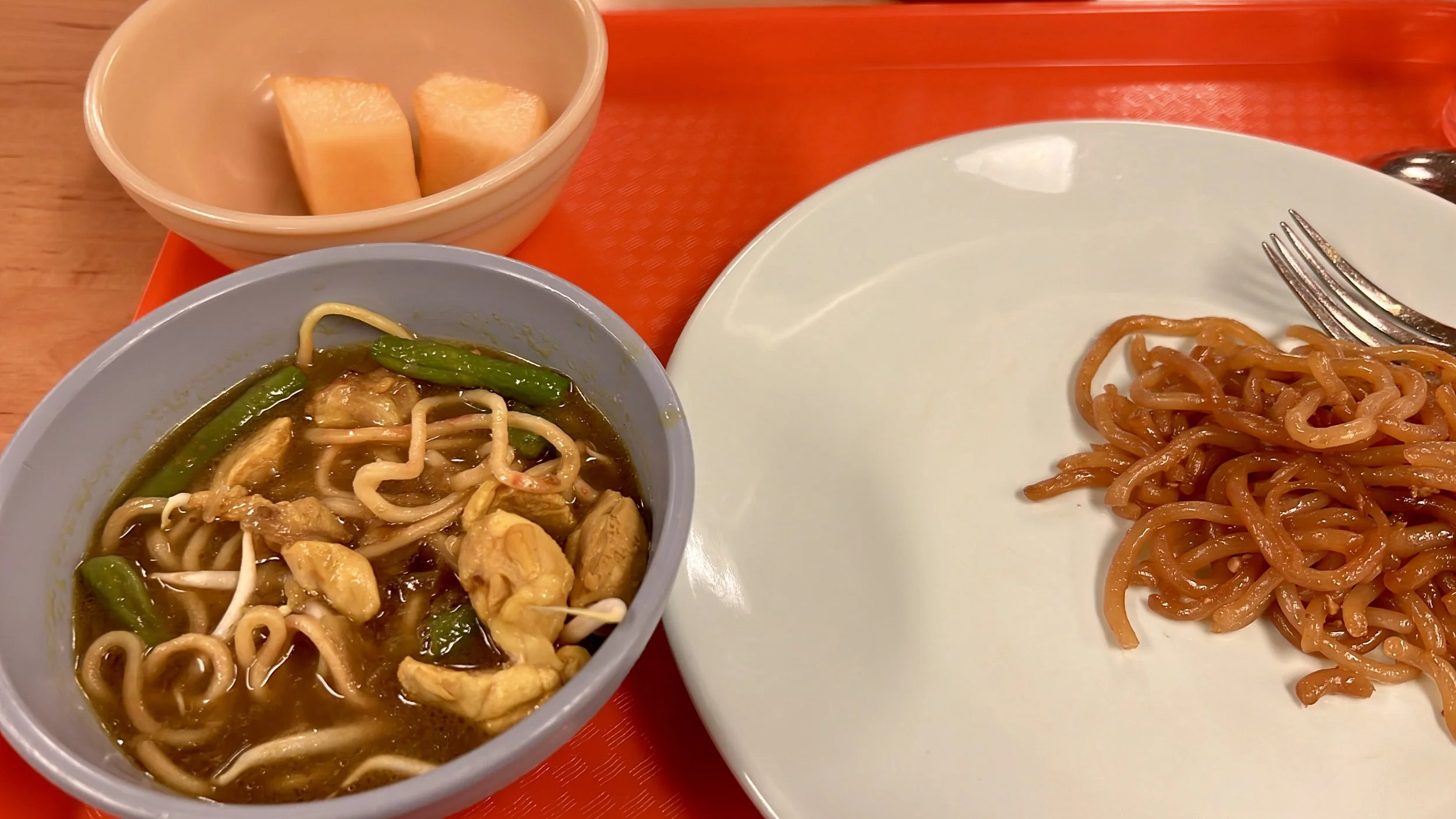
Malaysian supper
Eating in the mess
There are a few routines you pick up pretty quickly. Some are actual rules, while others are simply things you learn by watching everyone else.
Hygiene is taken seriously. Crew members from different departments use the same dining spaces every day, and when you're living and working together onboard, illnesses can spread quickly.
There’s also a dress code. Tank tops, shorts and slippers aren’t allowed, and if you're wearing coveralls from an engine or technical department, you generally wouldn't sit down in the officers mess wearing them. You could pick up your food and take it to the crew mess instead.
Using phones at the table during meal times is generally frowned upon. During Covid-19, this was enforced more strictly as part of the hygiene measures onboard.
There is a practical reason for discouraging it too: during busy periods, sitting around on your phone after finishing your meal meant taking up a table that someone else might need. Outside meal times, this is generally more relaxed.
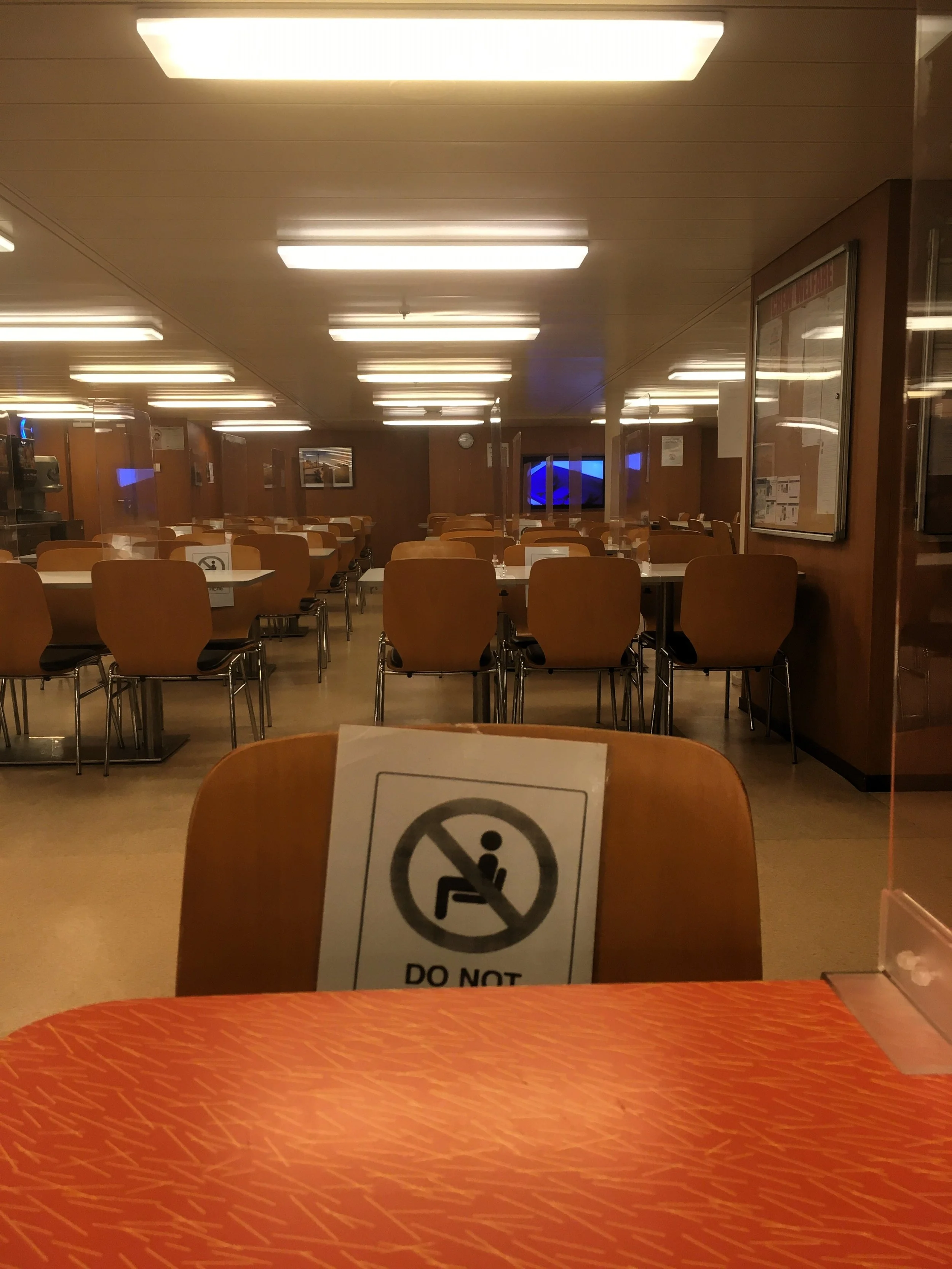
Social distancing in crew mess during the pandemic
Food generally isn't supposed to leave the mess unless there is a specific reason or permission to do so, such as when someone is isolated in their cabin.
Meal hours are fairly fixed because the ship has to feed people working around the clock. Meal times in the officers mess were posted on the door in the 24-hour format we used onboard:
0600–0900 — Breakfast
1100–1400 — Lunch
1700–2030 — Dinner
0000–0200 — Supper
The crew mess generally opens and closes 30 minutes earlier.
I’ve experienced different supper arrangements across the ships I worked on. Supper could be served in the crew mess, officers mess, or both, and the first part of the service might be prioritised for crew who were working or about to report for duty.
The mess could get particularly crowded when a meal service first opened. The officers mess could feel especially busy at these times, while the larger crew mess generally had more room to absorb the crowd.
Lunchtime around noon is usually the biggest rush, when several departments have breaks at roughly the same time.
I usually tried to avoid the busiest periods when I could. As a slow eater, I preferred having a little more time and space rather than spending part of my break queuing for food.
Even though the menu followed a weekly rotation, we still want to know what’s being served. My department takes our meal breaks one at a time, so when the first person goes to the mess, those of us still in the office inevitably ask, “What's the food?”
Sometimes the answer is enough to put everyone in a better mood. Other times, you might see someone in the crew mess cooking instant noodles instead.
Seating is another thing you figure out without anyone explaining it. There is no assigned seating, but people naturally develop their usual tables and groups. Some sit with their coworkers, some with friends, and others gravitate towards the window. I might be revealing too much about myself here.
In the officers mess, there’s a designated captain's table, usually marked by a slightly nicer tablecloth and its own condiments. As a trainee, I once sat there without realising it. Nobody said anything, but I quietly filed that information away. I never did it again unless every other table was full.
Sharing a dining room with so many other people comes with a few basic courtesies. You take a tray so that your table is left reasonably clean, and when you're finished, you return it along with your plates and cutlery. Any food scraps go into the wet waste, while other rubbish goes into the dry waste.
These might seem like small routines, but when the same dining spaces are being used by crew throughout the day, they help keep things running smoothly.
While you're eating, you’ll often see the galley staff coming in and out to replenish the food. Behind those buffet counters is a fairly enormous operation. Meals have to be prepared for hundreds, sometimes thousands, of crew members and kept replenished throughout each service.
The schedule starts long before most of us sit down to eat. Breakfast preparation can begin as early as three or four in the morning, followed by lunch, dinner and supper throughout the day. It’s one of those jobs onboard with a particularly unforgiving schedule because the ship’s food operation doesn’t get to take a day off.
If you've worked on a cruise ship, I'd be curious to know what your crew mess looked like and whether it had the same setup.
Read more:
Similar Posts




Popular Posts




Something funny happens at the end of every cruise ship contract. You think, maybe just one more. Until you don't.